
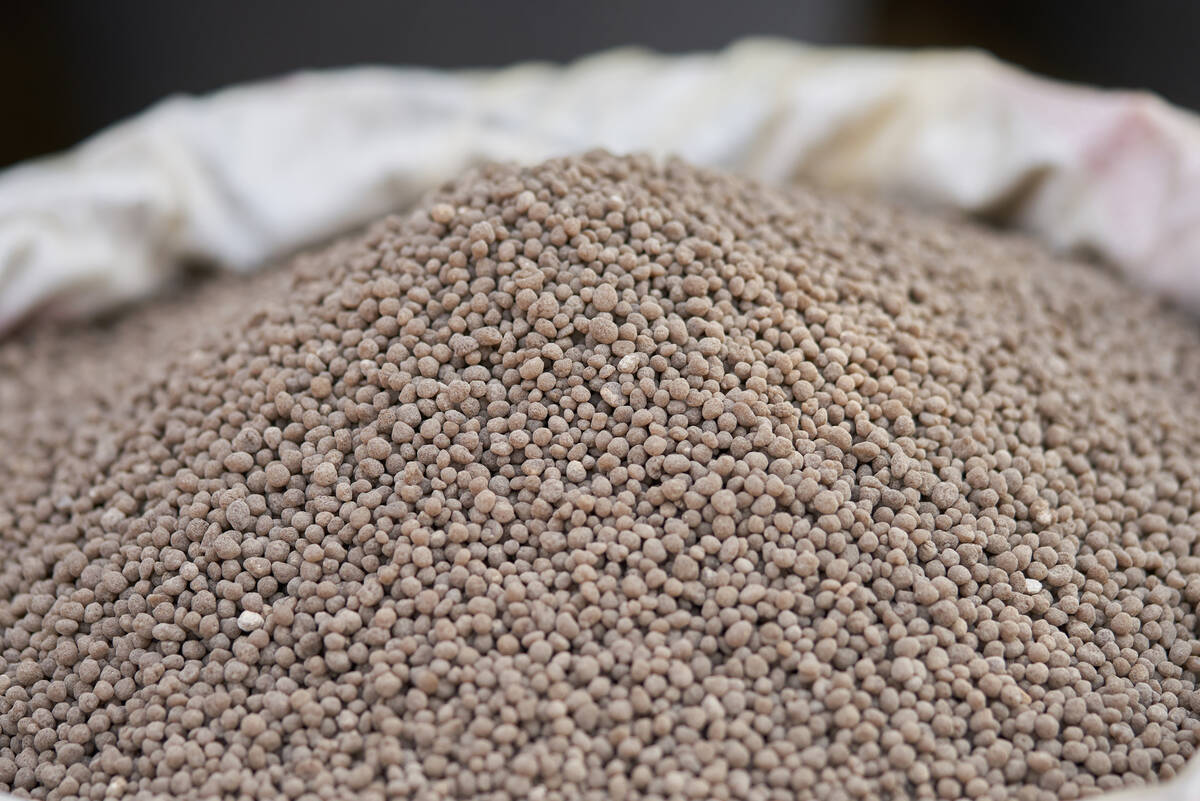
Questions about seed-placed phosphorus, and how much is safe for canola, echo around the Prairies each spring. Unfortunately, there isn’t a tidy answer.
Yield loss isn’t the real risk, says Chris Holzapfel, senior soil scientist with the Indian Head Agricultural Research Foundation (IHARF). More accurately, it’s about stand establishment, so “safe” phosphorus rates are less about protecting yield than about managing stand loss. The tipping point of that trade-off between nutrient and risk to the stand varies from field to field.
WHY IT MATTERS: With input costs putting pressure on slim profit margins, farmers want to know that the fertilizer decisions they make for the coming spring have the best chance of paying for themselves.
Read Also
Is inflammation the real cause of milk fever in cattle?
UAlberta researcher Burim Ametaj’s theory challenges 200 hundred years of science and his work may change the approach for treatment.
Holzapfel’s work, outlined at the 2025 Manitoba Agronomists Conference in December, spans three Saskatchewan sites (Scott, Indian Head and Melfort) and several trial results. It found that canola didn’t yield less with seed-placed phosphorus, but there could be fewer plants. Depending on soil, moisture and fertilizer blend, there could be much fewer plants.
Canola, however, has a knack for filling in the gaps of a lean plant stand.
Counting up yield
More than a third of sites showed no yield response to phosphorus at all, despite less than impressive soil test phosphate. Most places went into the trial with moderate soil test levels, roughly 15 to 20 parts per million of phosphorus. Where yield responses did occur, they varied in size and consistency.
Some site-years showed a modest, fairly linear yield response to added phosphorus. Others did not respond at all, even where soil test phosphorus was relatively low.
“In some cases the yield response was pretty strong. In some places it was small,” said Holzapfel. “In some cases it wasn’t there at all, but never negative.”
The lesson, says Holzapfel, is that phosphorus doesn’t always behave predictably, and low soil test values don’t guarantee a yield response in a given year.
But one thing was true across all sites: there was no negative yield impact when comparing unfertilized checks to fertilized treatments.
The type of phosphorus also yielded only a few bushels to the acre difference, suggesting source mattered less than placement and overall fertility strategy. Melfort was one exception. There, pure struvite performed poorly over two site-years. Blends did better.
Holzapfel couldn’t say exactly why the Melfort data stood out, but it’s another reminder that local conditions can override expectations.
“I don’t really know what it is about this site,” he said
Stand loss rises with rate
When emergence data was averaged across all sites, higher seed-placed phosphorus rates were generally linked with modest declines in plant stand density. Differences among fertilizer forms existed, but they were smaller than differences driven by rate and site conditions.
Some phosphorus sources appeared gentler on emergence when seed-placed, but that didn’t automatically translate into yield advantages. Canola compensates by branching and filling in the canopy later in the season.
That’s an important distinction, conference attendees heard. Establishment and yield don’t always move together.
Soil and location matter
Trials at all three sites also highlighted just how sensitive outcomes can be to soil texture, pH, organic matter and moisture.
At Indian Head — a higher pH site with more moderate organic matter — no emergence issues were observed with side-banded phosphorus across all tested rates. Seed-placed phosphorus reduced plant counts as rates increased, but stands generally started strong and tolerated the stress better than at other locations.
Results from Scott told a different story. Plant populations were lower to begin with, and seed-placed fertilizer, especially when ammonium sulphate was included, appeared to have an impact.
“As soon as they threw that ammonium sulphate into the seed row, right off the bat they lost a fair number of plants,” he said.
Those plots showed the kind of damage Holzapfel would expect from too many ammonium salts concentrated in the seed row, although he could not say for certain that salt stress was fully to blame.
Where is the real seed risk?
A farm’s acceptable risk to seed-placed phosphorus depends on field conditions and management goals, attendees heard. Farmers will want to weigh factors like:
- soil texture and moisture,
- pH and organic matter,
- fertilizer form,
- whether other products, like sulphur, are included in the seed row, and
- how much stand loss a grower can tolerate.
Work cited by Holzapfel supports a conservative approach: Side-banding is still the most reliable way to apply higher phosphorus rates without risking emergence.
Seed placement can work at modest rates under the right conditions, but the margin for error is narrower, especially on sensitive soils or in dry springs.
Holzapfel added that farmers should be cautious of marketing campaigns promising a silver bullet when it comes to phosphorus. While newer products may offer handling or seed-safety advantages, long-term fertility still comes down to applying enough phosphorus, in a safe way, to maintain or build soil fertility.
“Remember, you are not only fertilizing the crop, but also the soil.” he said.