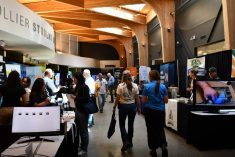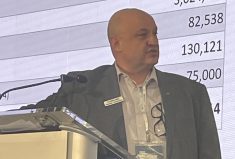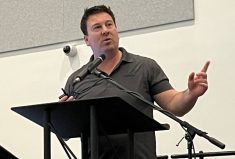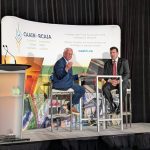

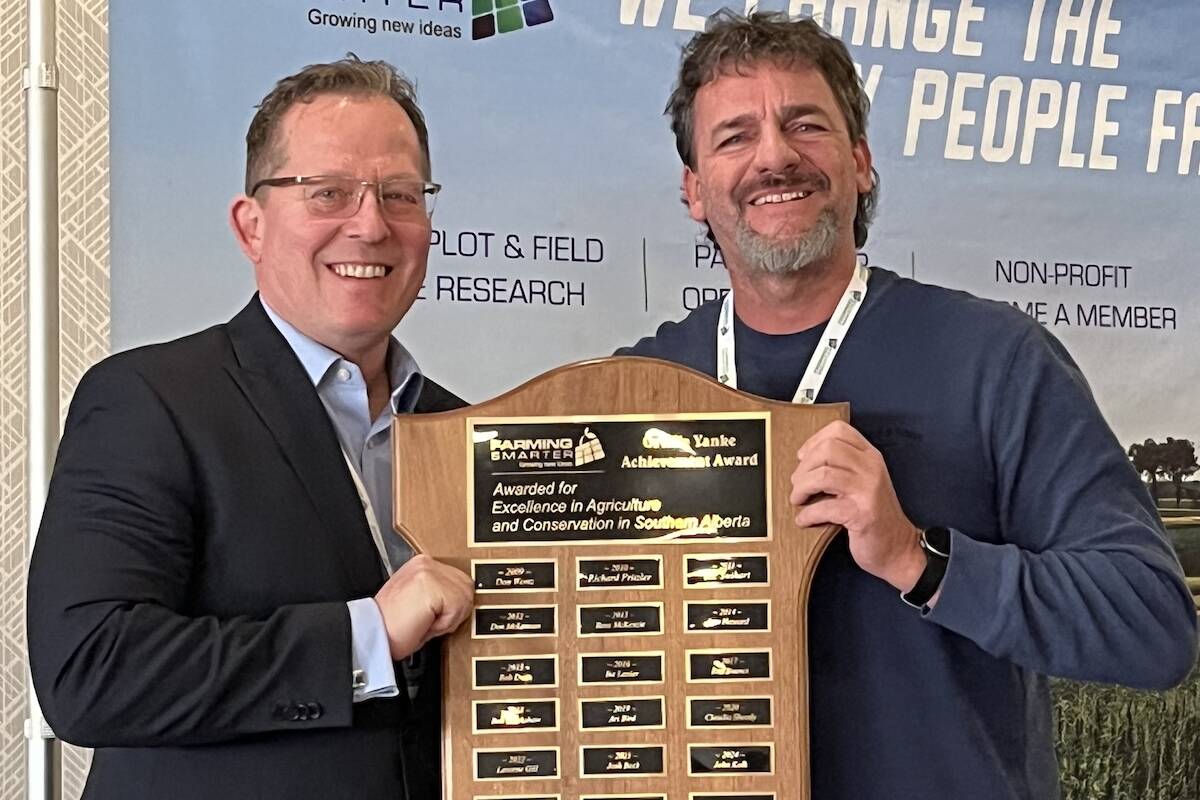
Dr. Brian Beres was on hand at the 2026 Farming Smarter Conference in Lethbridge, Alta., to speak on his three decades of scientific contributions to sound agricultural practice.
His presentation was entitled Life of Brian: Decades of Advancing Wheat Research. That life was celebrated as a recipient of the Orville Yanke Award for Excellence shortly afterwards.
Beers helped pioneer the Genotype x Environment x Management (GEM) framework in Canadian agriculture, which redefined how cropping systems are designed and optimized under climate variability. His 131 peer-reviewed articles and two books in research has impacted agriculture for the better in many different ways.
Read Also
Perry Family Farms makes its way onto world stage at Davos
Southern Alberta potato farmer gets a seat on the world stage to talk about the economic potential and challenges of regenerative agriculture at the World Economic Forum in Davos, Switzerland.
“(He) changed agronomy and started the research component and dealt studies, which included snow-trap techniques, various crops, ethanol feed stocks and various agronomy methods in winter wheat production, and work in PGR and other cropping variables,” said Ryan Dyck, a childhood friend of Beres, growing up near Readymade, who has served as a technician for Beres for 29 years with Agriculture and Agri-Food Canada.
“From extensive agronomy and saw fly experiments, Brian was the first to show different harvest methods and harvest sites lead to enhanced parasitoid conservation.”
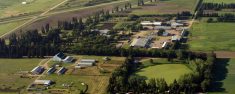
Beres established an agronomy program at the Lethbridge Research Centre when he became a biologist in 2000 and later its research scientist. Throughout the years, the program has had hundreds of students and numerous technicians and labourers come through the door, many of which still work with AFC. Dyck estimates at minimum, the program has seeded over 500,000 research and evaluation plots, with thousands saved by Beres from flooding.
“Experiments in all types of crops, from corn agronomy to running the Alberta corn committee trials, he has done it all,” said Dyck.
“Designing a zero tillage experimental block drill, to becoming the head scientist leading the way, using an ultra-early seeding system on their farms, reducing consequences of climate change.”
Orville Yanke was one of southern Alberta’s earliest and most ardent soil conservation leaders. The Medicine Had farmer played a pivotal role in founding both the Southern Alberta Conservation Association and the Southern Applied Research Association.
The two organizations merged in 2012 to form Farming Smarter. Farming Smarter has presented the Orville Yanke award annually to individuals whose contributions have significantly impacted soil conservation research and extension in southern Alberta.