
Farming can be a stressful job any month of the year, but the wave of decisions leading to planting season can intensify uncertainty and anxiety.
Practical solutions and community support can help farmers manage stress, mental health advocates say.
Read Also

Do More Ag to fund rural groups’ mental health workshops
The Do More Agriculture Foundation announced on Monday that it had opened applications for its 2026 Community Fund for Mental Health, which funds and supports rural communities to host mental health workshops.
Why it matters: Farming can be one of the most stressful professions in Canada, with farmers experiencing higher-than-average rates of depression and anxiety.
As spring begins, farmers are thinking about what to plant and which seeds and crop protection products to use. Meanwhile, weather, markets and geopolitics are out of their control.
“Think about the farmers across the country who experienced droughts, who experienced flooding, who experienced tariffs,” said Chad Bouma, a social worker practicing in the rural area around Drayton, Ont.
“All those things probably have been going through their mind since the harvest time.”
Bouma said he’s seen the stress and anxiety lead to decision paralysis.
“Those farmers have real difficulty even kind of making those decisions, because they don’t want to make the wrong decision, because maybe the decision they made last year was the wrong decision.
Stress clouds the judgement ‘window’
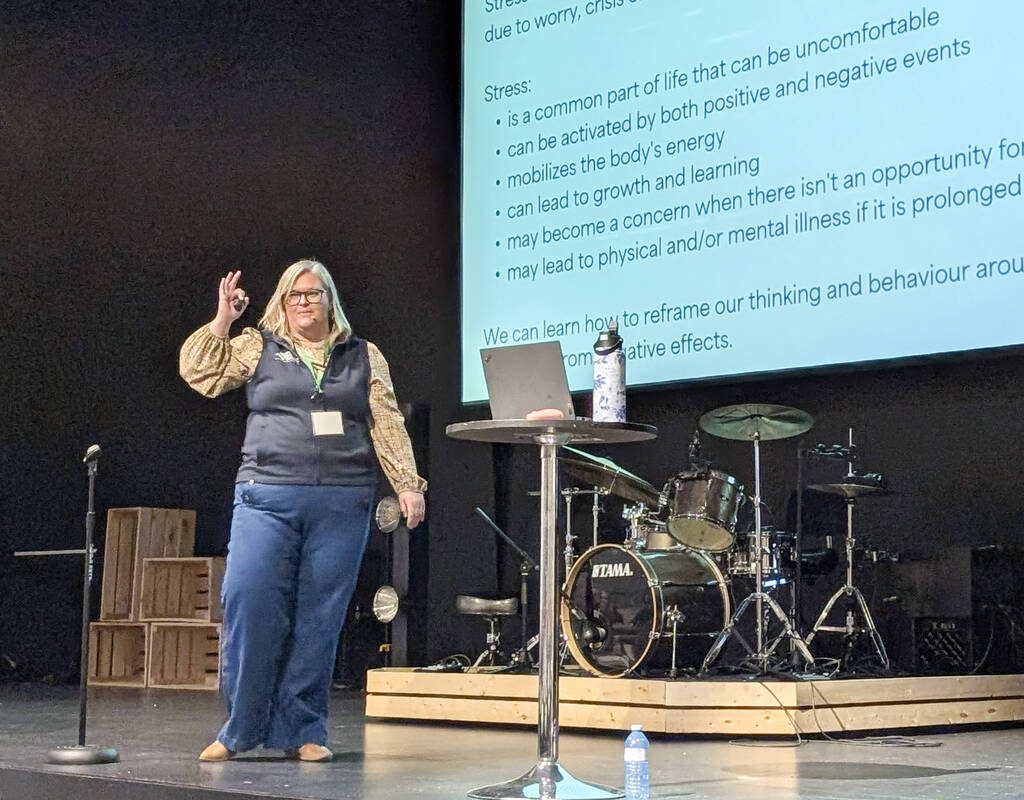
Stress can often cloud a person’s judgement and decision-making abilities said Megan Burnside-Poitras, communications advisor with Agricultural Wellness Ontario. Burnside-Poitras spoke at the Eastern Ontario Crops Conference earlier this year.
In her presentation, she compared stress and judgement to a window.
“I look out my office window in the afternoon. I’m looking out into the farm, into an orchard. It’s a beautiful window to look at.”
“Most days, you know, that window is pretty huge, a big picture window, and it’s very clear, and I can see how beautiful it is out,” she said. “But occasionally, it’s harder to see out that window.”
In times of higher stress, it is common to experience ‘hyperarousal,’ an agitated state with higher energy, or ‘hypoarousal,’ a state of shutting down. Both these situations can cloud that window.
“It’s a whole lot harder to see that same beautiful visual that’s on the other side of it, even though it’s still there, because things are getting cloudy because of that stress.”
Outside factors like weather, tariffs, market prices and public perception can “draw the blinds” on the window, obscuring the view.
How farmers can manage stress
Bouma said the role of a social worker is to give farmers the tools to see their situation clearly and understand when they need support.
“Some farmers experiencing anxiety, they don’t know that it’s anxiety,” he said. “They might just think it’s stress that they can’t get over, and then they beat themselves up.”
Recognition and awareness-building are critical.
“A lot of the time we don’t actually know that there’s something wrong until something catastrophic has happened, or there’s a crisis,” Bouma said.
One of the most important things in high-stress times is to focus on prevention and mitigation measures, Burnside-Poitras said. This means identifying stress triggers, how they can be mitigated and focusing on what can be controlled. This could be as simple as staying rested, hydrated and well-fed.
Community a mental health advantage
When it comes to mental health, the advantage in agricultural communities is just that: community.
Burnside-Poitras cited a study from Stanford University which concludes “Social ties in general are going to lead to lower stress, anxiety and depression, higher self-esteem, greater empathy, increased trust and cooperation and enhanced well-being altogether” as well as a 50 per cent chance of a longer life.
“The community perspective for mental health and farming is the most important piece of this,” Bouma said. “I cannot emphasize that any stronger.”
“When we isolate (mental health) or we individualize it, then it’s not going to go very far, is it?”
“There’s a lot of resilience already built into farming,” he said. Farmers have often seen previous generations go through similar seasons.
Keeping the community connection can mean checking in on neighbours or getting involved with local community groups.
The rhythm of the seasons can also provide critical reflection time. Bouma said some farmers will do this on their own, while others may draw on peer groups.
“They are looking for practical solutions,” he said. “Hoping for the best is all well and good, but they also need to have pen to paper for that too.”