
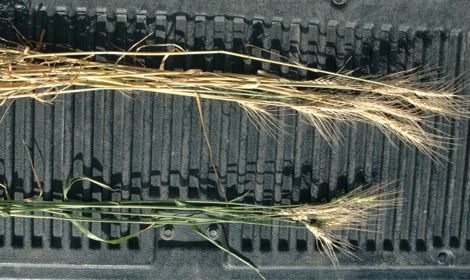
It’s late in the growing season, but there is still time to scout wheat crops for disease. I first noticed serious disease in my midge-tolerant Goodeve wheat near Dundurn, Sask., not long after flowering.
It took me a while to figure out what was going on; I now know that these diseases are widespread in the Saskatoon area.
While I am a dirt-digging soil scientist and farmer, not a plant pathologist, I think the disease shown in the photo of a neighbour’s Carberry wheat is aster yellows (it hasn’t yet been confirmed by lab tests).
Read Also
CBOT Weekly: USDA predicts declines in planting intentions
Declines in projected planting intentions for 2026/27 were not as big as the market expected, after the United States Department of Agriculture released its estimates on March 31. The USDA also issued its quarterly grain stocks report with stocks for soybeans bigger than anticipated, while those for corn were smaller and wheat virtually matched the average trade guess.
Yes, aster yellows can be a wheat disease, and doesn’t just impact canola. Aster yellows is not a fungus — there is no spray solution. To scout for aster yellows in wheat, look for a white head, with little or no seed. The flag leaf will be curled, with little left, or it may be gone. The stem will still be green in the early stages.
It’s easy to confuse aster yellows with fusarium head blight. All farmers know about FHB and what it can mean, especially in Manitoba. The thought of augering a wheat crop into the bush turns the stomach of any wheat grower. If you have head blight, the heads (or parts of the heads) will be white, but the flag leaf will still be intact, and the plant will still be green.
— Les Henry, a contributing columnist for Grainews and a retired soil science professor, farms and writes in the Saskatoon area.