


Growers need to hear about diseases that affect their crop, said Keith Gabert, provincial canola agronomist with the Alberta Canola Producers Commission.
The big four diseases right now are:
Read Also
First Canadian trial of Halter virtual fencing system underway near Westlock
The New Zealand-designed system uses GPS collars and is now eligible for OFCAF funding in Canada.
- blackleg
- verticillium stripe
- clubroot
- Sclerotinia
WHY IT MATTERS: Growers can sometimes ignore early signs of disease in their fields until it is too late.
“You tend to react fairly rapidly to insects, things that move and crawl and kind of get your attention, but diseases kind of sneak up on us,” said Gabert at Alberta Canola’s grower engagement meeting in Stony Plain, Alta., in November.
Gabert said he likes growers to have a good idea of what their canola looks like in the field, particularly at the end of the season, and get feedback on how their crop yielded.
Healthy canola stems should look clean and white, with no fungal or disease growth plugging them up.
He said the inside of the canola stand should look clean, green and healthy, and if it doesn’t look like that, then a grower may have a problem.
By pulling a canola stem, growers can check for all four major diseases.
“It takes five to 10 minutes in the field to give you a good idea of what you’re looking at,” Gabert said.
Last year was dry, and since there was no rain during harvest, growers are going into the winter dry.
“We’re coming into the year with some uncertainty, the same as the year we came out of,” he said.
Genetics and seed treatment can make a big difference in fighting disease and insects.
Gabert told growers at the meeting that their crop will talk to them, and they must be prepared to listen to it.
“But as I move into what I call the big four diseases, I just want to dwell on the fact that whether you can identify specific things is not important,” he said.
“The important thing that I convince you is to cut into those stems,” Gabert said.
This simple test will check for clubroot, blackleg and verticillium stripe.
Growers can take unhealthy canola to their seed retailer, who should be able to identify problems.
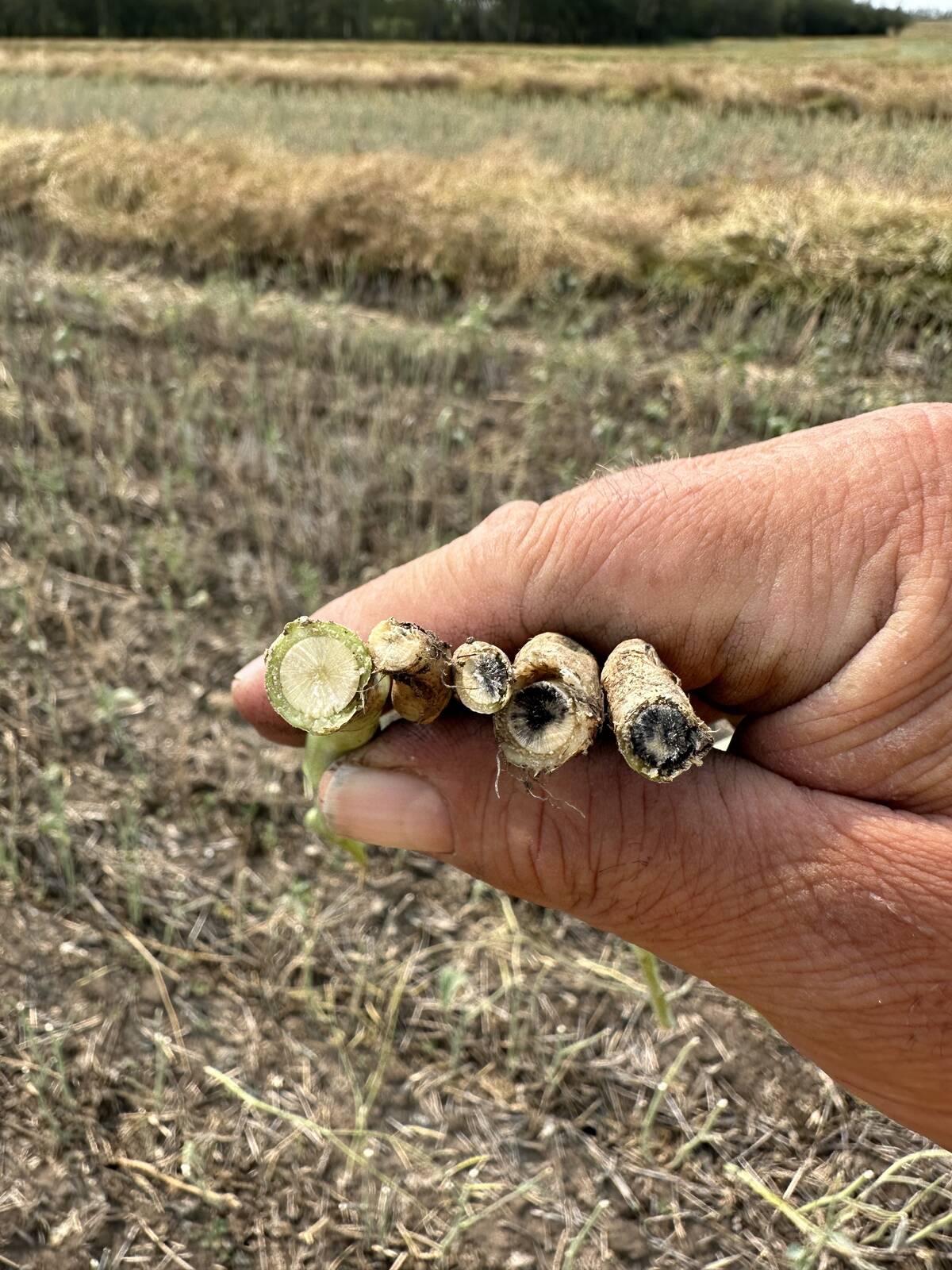
Blackleg
“The best way to get a bad blackleg infestation is to have a favourite variety and grow it about six times in the same field. Now chances are that’s a wheat-canola rotation and it’s taken you a dozen years, and your variety or hybrid probably changed in that time,” he said.
“A decade ago, we did have a couple varieties that lasted that long, and that tended to be where we saw blackleg infestations.”
“While our genetics are good, disease will find a find a way to get around genetics.”
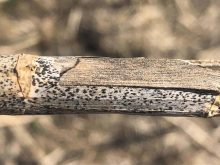
Gabert said fields with blackleg problems have stubble pieces with little black peppery spots on them. These are spore bodies that throw up spores for blackleg to infest the next crop. The best time to look for blackleg is after swathing or straight cutting.
There have been a few genetically resistant varieties of canola for blackleg, but resistance has broken down over the years. Growers with blackleg problems should change their resistance groups. If a grower picks a variety with the same or weaker blackleg resistance package, they should be aware that blackleg can cause a big yield loss.
“Farmers don’t use this tool very often, but you can take those same stubble pieces that you’ve been cutting and looking at and see if they’re clean. If they’re not clean, collect up a dozen of them and send them to someplace like 20/20 Seed Labs and they will resistance test them and tell you what race of blackleg is infecting those plants,” he said.
To scout for blackleg, growers should cut at the junction of the root in the stem and look for clean white tissue. Gabert said he cuts two-and-a-half inches lower than he used to for blackleg.
Blackleg is an airborne disease.
Verticillium stripe
Verticillium stripe, a relatively new disease, is a soil-borne disease caused by microsclerotia that live in the soil and plug the stem of the canola.
The disease has significant symptoms. There is shredding almost like Sclerotinia on the stem, black peppery microsclerotia and microspore bodies that carry the disease forward in the soil. The soil will look bleached and ugly.
“It’s been around about 10 years, really taking a bite out of Manitoba’s canola yields,” Gabert said.
However, he hasn’t seen severe symptoms of the disease in Alberta. In Manitoba, growers have found disease can take away about 20 per cent of their yield.
He said the best way to manage verticillium stripe disease is to manage blackleg aggressively, because both diseases do similar things in the stem. When the two diseases are found at the same time, the impact is more pronounced.
A little verticillium stripe will not have the same impact on canola if blackleg is not present.
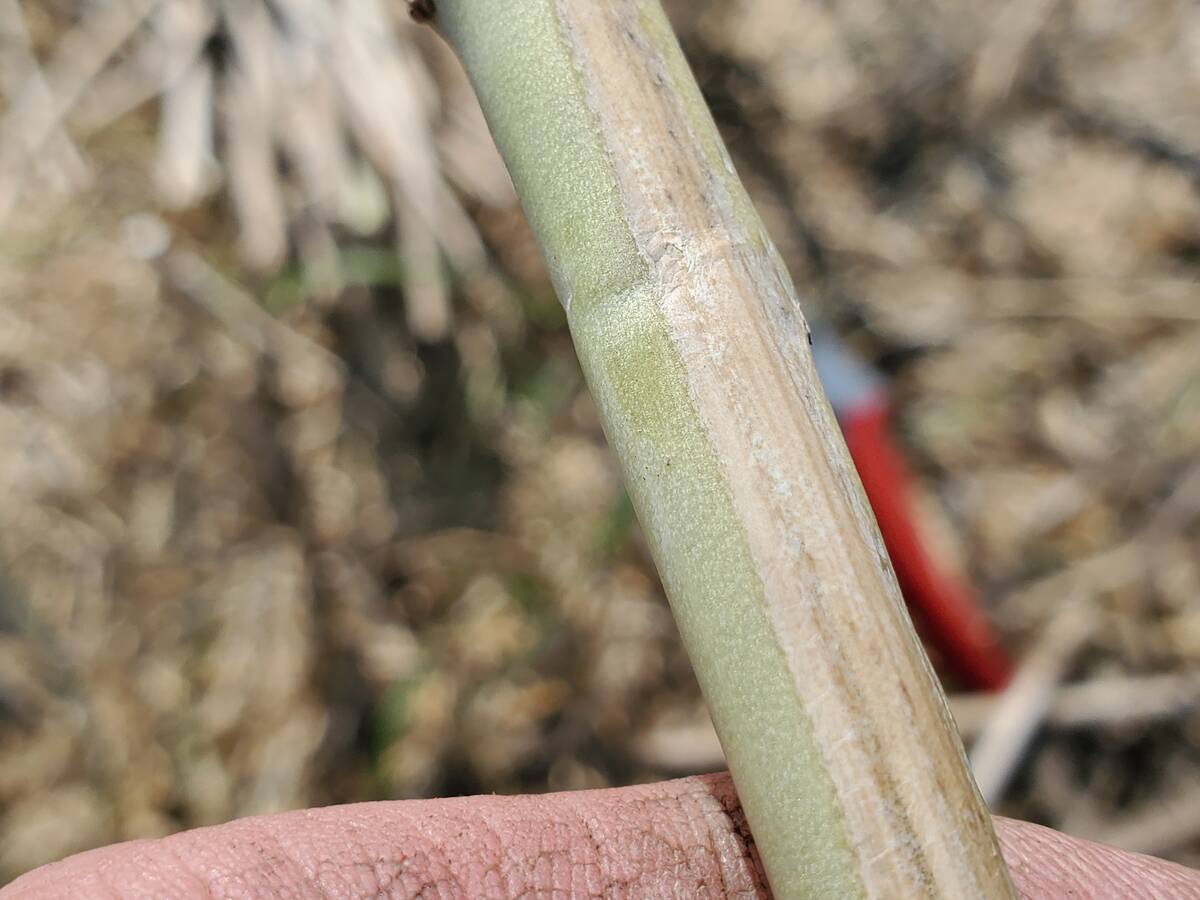
Verticillium stripe discolours the stem, plugs the xylem and inhibits the transport of nutrients and water in the stem of the canola. Verticillium stripe grows from the bottom up, so it’s a good idea to cut two inches into the root.
“Sometimes you’ll find that gray fungal growth or evidence of some plugging further down in the roots than you normally would for blackleg,” he said.
“It’s easy to do the two. The take home message is you’re looking for clean white tissue in the root.”
Verticillium stripe plugs much less than blackleg. When it plugs the stem, it appears in more of a starburst pattern.
“If you’re really lucky and you start cutting in the roots far down, you can actually follow which root brought it into the main stem,” he said.
Clubroot
Clubroot is still a problem, and scouting for it is best done after swathing. It doesn’t take many spores to cause a clubroot infection.
“You’ll probably have both white galls and some brown, older, mature galls that look like peatmoss falling off,” he said.
“If you don’t have roots on your canola that look normal, and maybe you’ve lost some of the root hairs when you pull them up, there’s a good chance that clubroot has digested or used or abused some of those roots.”
If clubroot is in a root, it will hijack the system, make its own home and widen portions of the roots further down.
Gabert said growers should get down on the ground and pull canola stems to check for clubroot, rather than assuming a field is bad once damage can be seen from the truck.
“By the time it’s thinned out, and visibly wilting on a hot summer day, you’ve got a lot of galls and lots of seed and a lot of spores,” he said.
There are a few weedy relatives of canola like shepherd’s purse and stink weed that are susceptible and can carry clubroot. Many Chinese vegetables like Chinese cabbages, bok choy and gai lan (Chinese broccoli) are brassicas and can also get clubroot. They are commonly grown around the world.
Gabert said the take-home message for clubroot is to keep it low and local. Seed spore on the fields should be kept low, and there should be at least a two-year break between canola varieties. Ninety per cent of the spores or seed for clubroot die in that first two years.
“If you’re on a one-in-three rotation, only 10 per cent of those spores will still be available. If you’re at a relatively low clubroot infestation and 90 per cent of those spores die, that’s not a lot of pressure for the genetics to try to deal with in your field. If you’re in a dead spot, and 90 per cent of way too many clubroot spores die, you probably still have way too many spores in those patches, if that’s the case. That will be some significant pressure on those resistance genetics that you use,” he said.
Gabert encouraged growers to manage the resistance available in seed varieties, and don’t let clubroot take over.
Patch management also helps.
If a grower finds a clubroot patch about the size of a large table in their resistant variety, they should go into the patch, pull out roots, toss the plants in a garbage bag and send it off to a landfill. That will get rid of a lot of spores in a hurry.
Having grass in the entry way to a field can also cut down on clubroot establishment, he said.
Sclerotinia
Gabert said many people feel sclerotinia is not a problem, when in fact, it’s still a big problem.
“I would like to think that this is a disease that can take the top end off a good crop,” he said.
“If you’ve got a yield potential of 40 bushels or more and a crop canopy that can stay wet, chances are that Sclerotinia can be an issue. It’s one of those break-even propositions most of the time.”
Frequently, when producers spray for Sclerotinia, they will get the cost of their fungicide and application back.
“You’re not going to be too excited about spending that much time in the sprayer. But on the odd year, especially when we used to swath, you’ll find big batches of sections of the field that just go poof. The stems have been digested. The seed hasn’t set in there. And you’ll pay for three to four years of application or maybe more in that single year,” Gabert said.
“Managing sclerotinia aggressively is important in my books, relatively simple, and we do have some good genetic tolerance from at least one of our seed suppliers.”
Gabert said additional information about diseases is available from the Alberta Canola Producers Commission. The Canola Council of Canada has a newsletter called Canola Watch that is a good source of information for producers.