

Investing is commonly perceived as something for the future, like retirement, that isn’t at the top of mind for young farmers.
But it should be.
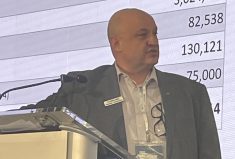
“If you guys (at 25 years old or younger), put $100 a month away until you’re 65 … you’re going to have well over a million dollars,” Judy Bray, a financial adviser at Edward Jones, said during the Saskatchewan Young Ag Entrepreneurs conference.
Read Also
Alberta pulse growers can claim tax credits on check-off dollars
APG confirms SR&ED tax credit eligibility for 2025 check-off payments
These high earnings come from compound interest when the dollars are placed in a high-interest saving account, but the earnings will drop to less than half if the investor waits until they’re between 26 and 35 years old.
Starting investments young is of growing consequence as Canadian life expectancy increases, with the average now at least 20 years later than the retirement age of 65.
“If you pull your money out when you retire and you don’t have it invested according to risk tolerance and all that fun stuff, you don’t have it invested, there is no way that money is going to last you,” Bray said.
Often, young farmers or those looking to get their start in agriculture are focussed on taking on land, purchasing equipment and growing livestock numbers. These farm elements are future earnings, but first there’s debt and a financial risk.
Bray said a balance needs to be struck between risks taken and financial goals. To do so, there are a few main pieces to talk through.
Map out your field
The first is determining personal values and goals to establish a plan of savings and investing to provide reward for the right amount of risk, whether it’s planning for farm succession or a hot holiday.
“I go back to your plan, and say, ‘What is the least amount of risk that we can take on,’ ” Bray said.
“Then I’m going to tell you that you’re going to be able to achieve your goal at the end of the day. If we make extra money, that’s great. Means you get to spend more.”
“Spend more” doesn’t equal frivolous, but more toward goals such as travel, purchasing a house or taking next steps in taking over the farm.
Don’t put your eggs in one basket
The next step is diversification — and no, not buying livestock for the grain operation.
In this case, it means placing money in multiple investments of varying types. Investments can be owned, such as stocks and mutual funds, or where money is “loaned” for interest such as high-interest savings accounts, bonds or guaranteed investment certificates. The latter is the less risky investment.
“Those are the two big types that you can have, and you want to own some of both,” she said.
“Because how it works in the market, and the way that you build your risk tolerance out, is you want a bucket of each so when the market goes down, fixed income investments go up, and vice versa.”
She added that when someone is first starting out with “owned” investments, it’s important to stick to quality investments such as stocks.
It’s also important to focus on what’s within individual control because headlines and market concerns can be distracting. However, an adviser will help navigate the situation.
If you’re worried, talk to your financial adviser about what it means and if it should be of concern, Bray said. If it’s of concern, they’ll let you know.
Usually, these doom and gloom scenarios lead to improved outcomes down the line. Bray compared it to a clear-out sale.
“Think about when you walk into the grocery store to buy your groceries,” she said.
“If you walked in and every shelf in that grocery store was 25, 30, 40 per cent off, would you guys all walk back out and not buy your groceries that day?”
No, it’d be time to stock up and buy more than was planned. The market is the same.
On the other hand, if these steps have already been taken, preparing for a possible downturn is the next step.
Weather-proofing your assets
Preparation includes reviewing investment plans, preparing for the unexpected and maintaining balance between income and equity for goals.
Investment also means acknowledging current assets, which includes oneself. Bray encouraged young farmers in the room to boost their emergency fund with three to six months of income and to obtain life insurance.
“Basically, when you look at your income and what you bring to the table for the rest of your life, you are your most valuable asset,” she said.
It’s a piece that not many young people consider, but in an industry such as agriculture, with market volatility and a high risk for farming accidents on top of regular life, making sure life expenses, such as debt and property, are taken care of in the worst case scenario is particularly important.
Recruiting a trusted advisor
The final factor to taking charge of finances is choosing the right adviser to help create a plan.
“When we start thinking about your actual financial goals and what you want to achieve, that’s always where the conversation should start,” Bray said.
“You don’t just want someone to tell you what to do and what the right answer is.”
The cost of delay
Investing early is the most effective way for young farmers to build wealth. As highlighted by financial advisor Judy Bray at the Sask Young Ag entrepreneurs conference, starting at age 25 with $100 per month can result in a portfolio exceeding $1 million by retirement.
The table below compares starting at age 25 versus waiting until age 35, assuming a consistent 12 per cent annual return to reach the million-dollar milestone mentioned above.
Starting age
25
35
Investment/mo.
$100
$100
Time horizon
40 years
30 years
Total invested
$48,000
$36,000
Balance age 65
$1,176,477
$349,496
Calculation tools: Growth estimates verified using the Bank of Canada investment calculator and the GetSmarterAboutMoney.ca compound interest calculator.