
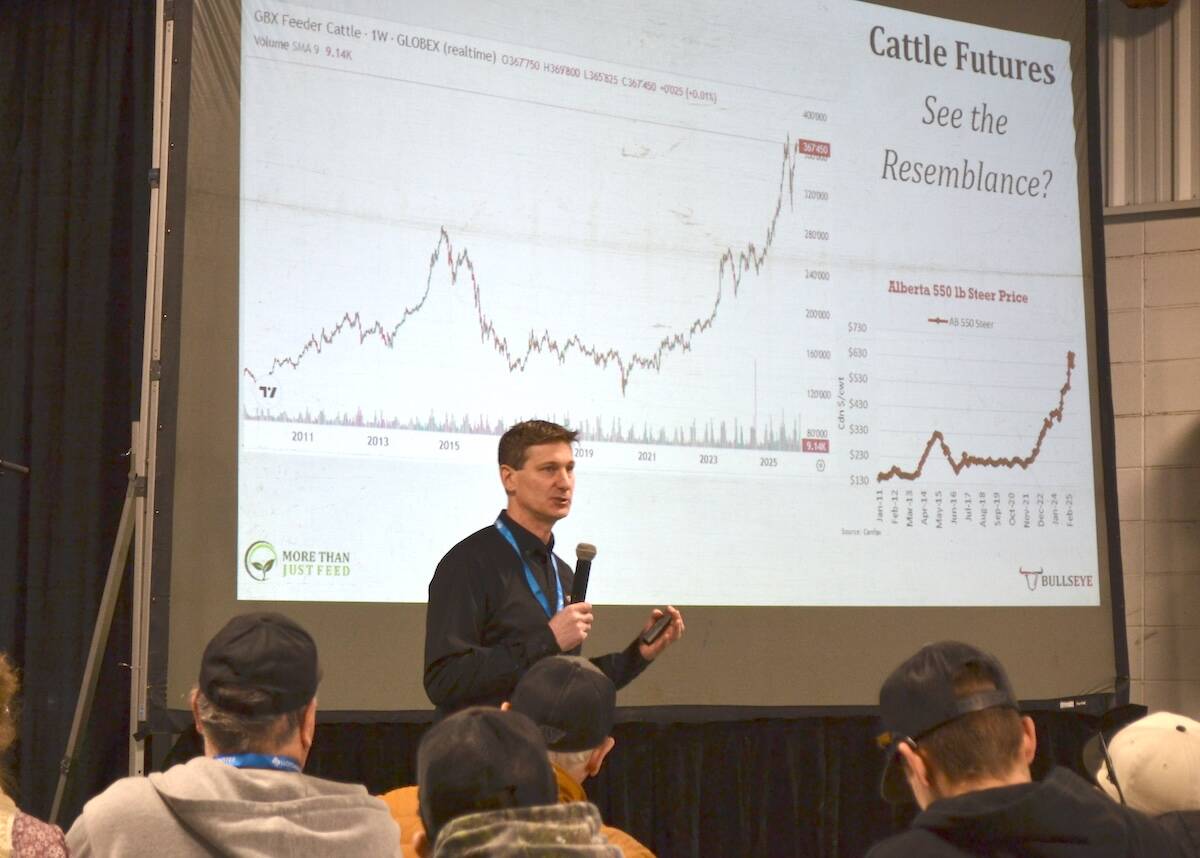
Global trade shifts, pest pressures and stubbornly strong consumer demand are reshaping the cattle and beef market, said Brian Perillat, agribusiness specialist with More Than Just Feed, at Agri-Visions in Lloydminster, Alta., on Feb. 11.
Perillat said North America is handling the smallest U.S. cable herd in 65 years at the same time as beef demand remains near record highs.
WHY IT MATTERS: A small Canadian cattle herd is being supported by high prices and even higher demand, but one agribusiness specialist urges producers to be prepared for when prices do fall.
While U.S. beef production hit a record high in 2022 and has since declined, supplies available to consumers have barely slipped because imports have surged.
“Almost 20 per cent of the beef we’re consuming in North America is now imported beef,” Perillat said.
Read Also
From deep cuts to double growth: Farming Smarter defies research crisis
Non-profit southern Alberta research institute showcases its growth in ag innovation on heels of federal cutbacks.
Brazil has emerged as a major force in the beef market, rapidly boosting output through better herd efficiency and limited feedlot finishing.
“In just a few short years, Brazilian beef production has skyrocketed … they are becoming more efficient overall,” he said.
Despite tariffs, Perillat said Brazilian beef can still land competitively in the U.S., and shifting Chinese quotas and tariffs may divert even more South American beef towards North America.
At the same time, pest issues and border policy are complicating live cattle flows. The long-running sterile fly program, used since the 1960s to control screwworm, has not fully contained the northward spread. The U.S. and Mexico border remains closed to some live cattle movements due to disease and pest concerns, such as New World screwworm.
New World screwworm has reemerged in Mexico just south of the Texas border. To date, there have yet to be any confirmed cases of New World screwworm in the U.S. since the breakout in Mexico.
The Canadian herd has still struggled to recover from BSE-era losses and recent droughts, Perillat said. But feedlot capacity has expanded.
More than half a million feeder cattle are expected to be imported from the U.S. this year, which Perillat said is a case of “too much money chasing too few cattle in Canada.”
He warned that today’s high prices are being supported by exceptional demand, and history suggests a correction of 25 to 35 per cent from cycle highs is still possible.
Perillat urged producers to use futures, price out insurance and take advantage of other risk management tools to protect against a potential sudden downturn in prices, especially as interest costs and feed prices remain key pressures.