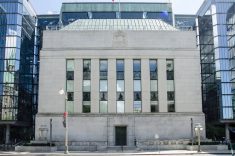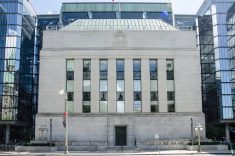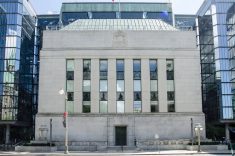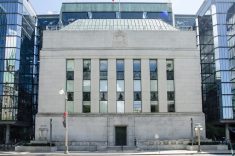

Ottawa | Reuters — The Bank of Canada held its key policy rate steady at 2.25 per cent on Wednesday as widely expected, and Governor Tiff Macklem said the economy was proving resilient overall to the effect of U.S. trade measures.
Despite tariffs between 25 per cent and 50 per cent on some critical sectors such as cars, lumber, aluminum and steel, Canada’s economy has shown signs of strength.
Read Also

Canadian Agricultural HR Council gets federal funds for workforce development tools
The Canadian Agricultural HR Council (CAHRC) is one of 14 groups set to receive federal funding to develop sector-specific information and HR tools to support workforce development, the federal government announced on March 9.
Third quarter annualized GDP grew by 2.6 per cent, much more than expected, while employment data showed the economy added 181,000 new jobs between September and November.
“So far, the economy is proving resilient,” Macklem said in opening remarks to reporters, adding that inflationary pressures continue to be contained. Overall inflation is just above the bank’s two per ent target.
“Governing Council sees the current policy rate at about the right level to keep inflation close to two per cent while helping the economy,” said Macklem.
GDP growth expected to be weak
Uncertainty remains high and if the outlook changes, the bank is ready to respond, Macklem said, reiterating comments he made when the bank cut rates in October to their current level.
The U.S. Federal Reserve will also announce a rate decision on Wednesday and a majority of economists expect it will cut rates by 25 basis points.
Macklem said even though the economy had shown some resilience, he expected GDP growth to be weak in the fourth quarter and hiring intentions to be muted.
While the economy is adjusting to tariffs, volatility in trade and quarterly GDP numbers are making it more difficult to assess the underlying momentum of the economy, Macklem noted.
The recent data has “not changed our view that GDP will expand at a moderate pace in 2026 and inflation will remain close to target.”
Andrew Kelvin, Head of Canadian and Global Rates Strategy at TD Securities called the bank’s commentary a fairly cautious tone.
“It leads me to be very comfortable with the idea that the bank will be on hold for quite some time,” he said.
Choppiness in inflation
The consumer price index eased to 2.2 per cent in October but economists have regularly flagged that measures of core inflation, which strips out volatile components, have stayed around three per cent, the top end of the BoC’s inflation target.
In the months ahead, the BoC expects some choppiness in headline inflation which would push inflation temporarily higher in the near term.
But Macklem said the ongoing economic slack would roughly offset these cost pressures. He said the bank expects the growth in final domestic demand to resume after registering a flat growth in the third quarter.
The Canadian dollar weakened after the announcement and was trading down 0.13 per cent to 1.3865 to the U.S. dollar, or 72.12 U.S. cents. Yields on the two-year government bonds fell 3.3 basis points to 2.556 per cent.
— Additional reporting by Nivedita Balu and Fergal Smith