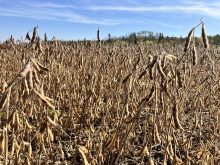


Chicago | Reuters—Chicago Board of Trade (CBOT) corn futures fell on Thursday, and soybean futures set new life-of-contract lows, as U.S. farmers scramble to sell their bins of old-crop grain and oilseeds into a global market awash in supplies, traders said.
Meanwhile, Chicago wheat futures spent much of the day higher on renewed signs of weather damage to European crops, but ultimately ended the day lower – following corn and soybeans, they said.
CBOT’s most-active wheat contract Wv1 ended down 3/4-cent at $5.37-1/2 per bushel. CBOT soybeans Sv1 ended 10-1/2 cents lower at $10.08-1/4 a bushel, while corn Cv1 fell 3-3/4 cents to $3.97 a bushel.
Read Also

Crude price may have topped says analyst
Any chance of crude oil prices skyrocketing higher became less likely on March 9, said Phil Flynn, senior market analyst at the Price Futures Group in Chicago. Flynn based that on the assumption that Iran’s military capabilities are declining quickly.
Some market participants said they were watching for impacts of the oilseed workers strike in Argentina, after the number of ships facing grains loading delays rose to 36 on Thursday.
Others focused on adjusting their positions ahead of Monday’s global supply-and-demand report from the U.S. Department of Agriculture, which many traders expect to forecast a massive U.S. harvest this fall even as Chinese demand this summer has cooled.
This over-supply perspective was reinforced early on Thursday, when traders began circulating a month-old USDA research report about flood damage to Midwestern cropland – which sent corn and soybeans falling as the damaged area appeared small, three market analysts told Reuters.
The 14-page document from USDA’s National Agricultural Statistics Service’s disaster monitoring team assessed damage to a small section of northwest Iowa, southwest Minnesota, and southeast South Dakota cropland that experienced heavy rainfall in late June.
The report stated that, in this area, an estimated 70,000 corn acres and 46,000 soybean acres were affected.
“Clearly, there is not a lot of fresh news right now,” said AgResource economist Dan Basse.
Soyoil futures rallied early in the day, but ended the session mixed, on news that the U.S. Environmental Protection Agency has launched investigations into the supply chains of at least two renewable fuel producers.
—Additional reporting for Reuters by Naveen Thukral and Sybille de La Hamaide