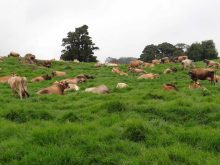


Darcy Goodrich likes what stockpiled grazing does for his bottom line and his land.
Goodrich farms in the Hardisty area on the eastern side of the province and has to deal with sandy soil, which is more likely to produce creeping cedar, cactus, and needle grass than useful feed for his operation, Pure Country Stock Farms. He turned to stockpiled grazing to both increase soil fertility and improve the diversity of the species in his pasture. Goodrich and his family produce grass-fed beef, free-range chicken and pork, which is sold through a retail store and at two weekly farmers’ markets.
Read Also
Is inflammation the real cause of milk fever in cattle?
UAlberta researcher Burim Ametaj’s theory challenges 200 hundred years of science and his work may change the approach for treatment.
“Stockpiled grazing is a way to reduce winter feeding costs and a great way to build up organic matter in the soil,” Goodrich told attendees at the recent Western Canadian Grazing Conference at Vermilion.
Goodrich has tested the soil in his pasture and has found most of it had less than one per cent of organic matter and the pH is anywhere between 4.8 and 5.5.
“When you have a pH of five, it’s very hard to get anything to grow,” he said.
But by using stockpiled grazing on a field that was previously continuously cropped, he has increased the organic matter in soil from 0.6 per cent to over two per cent in five years.
“It just sounds like a statistic, but I’ve had soil scientists tell me that you can’t build that amount of organic matter in that amount of time,” he said. “This is really encouraging stuff for us.”
His stockpiled grazing has varied as a result of what he can grow. Weeds need to be built into his grazing plan.
“We’re at a point now where we’re banking 30 to 50 per cent of all of our acres every year for use in the fall, winter and spring,” he said.
Stockpiled grazing has an additional benefit as it allows plants to rest and recover before they are regrazed.
Native species return
Allowing plants to mature and set seed resulted in species returning after years of absence, said Goodrich. This allows for a more natural and diverse stand.
“Since we direct market our beef, I’ve really learned how important it is to have a diverse forage stand. We’ve seen an improvement in the quality of our beef,” he said. “We have to have higher-quality forage to do winter grazing. Cows can survive out there all winter with no feed other than forage, if it’s of sufficient quality.”
The improved quality of the land has produced a spinoff benefit of healthier water supplies.
“We’re seeing more of a flow in our naturally occurring springs,” he said.
Goodrich has tried a variety of different grazing techniques including swath grazing and bale grazing. He has also bale grazed hay on native prairie wool in order to build up organic matter in his soil.
“We just scattered the bales around, pulled the twine off and turned the cows out,” he said.
By stockpiling, then bale grazing, and then stockpiling a pasture for a year, Goodrich was able to increase the protein in one pasture from about 6.9 per cent to about 12 per cent.
Not all cattle are suitable for use in a stockpiled grazing system. If cows cannot adapt to his system, Goodrich may remove them and put them on to a higher-quality feed.
“We’ve got cattle from all different backgrounds that work in this system. It’s not about breeds,” he said.
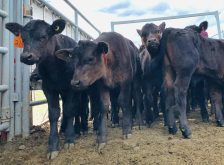
Goodrich raises Galloways, Galloway/Highland cross and Galloway/Angus cross. He starts calving in May and doesn’t wean until March, depending on the weather.
Goodrich only grazes each pasture once, and never hits a pasture at the same time every year. He grazes pigs and chickens on pastures after they have been grazed by cows.
———
“We’vegotcattlefromalldifferentbackgroundsthatworkinthissystem.It’snotaboutbreeds.”
DARCY GOODRICH