

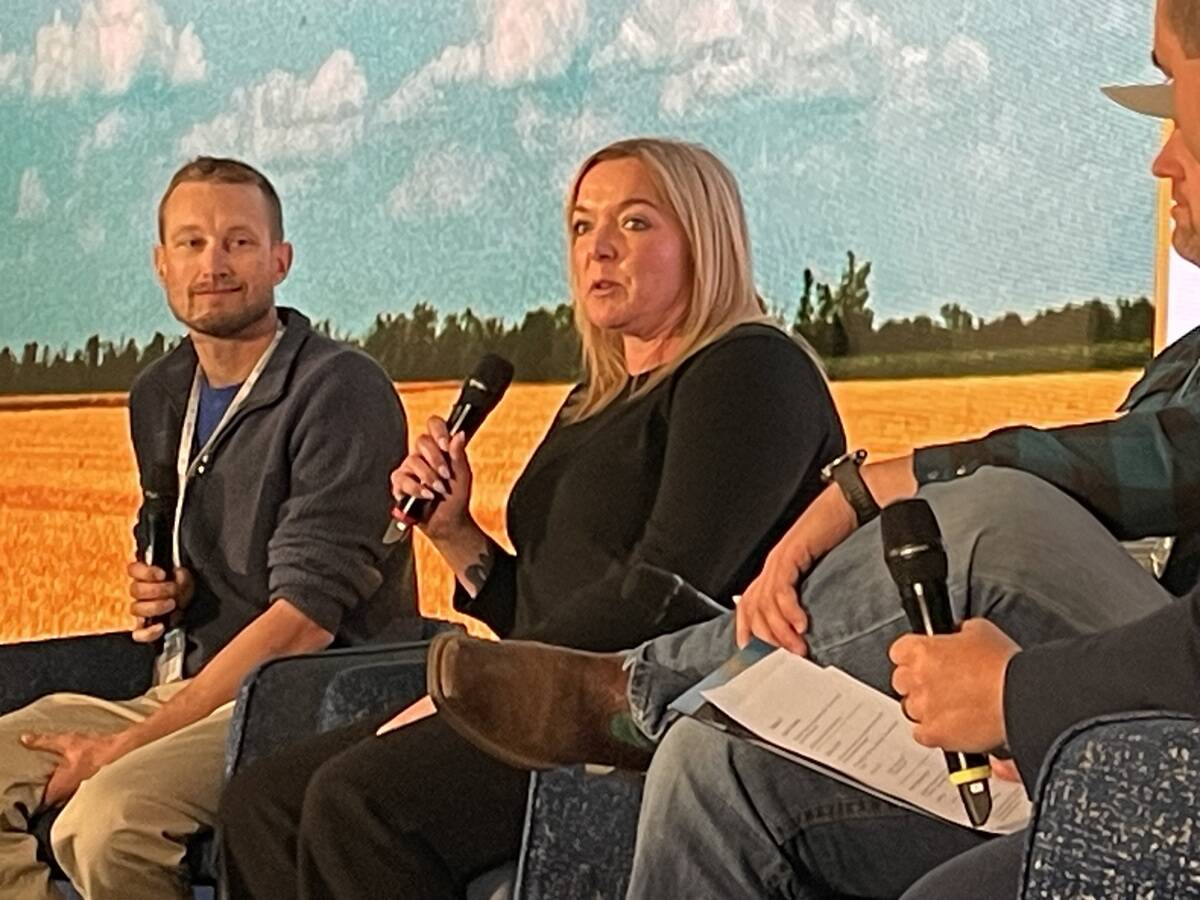
Managing employees, the role of AI in farming and decisions over tech investment were some of the subjects highlighting a Crossroads Crop Convention expert session Jan. 27 in Edmonton.
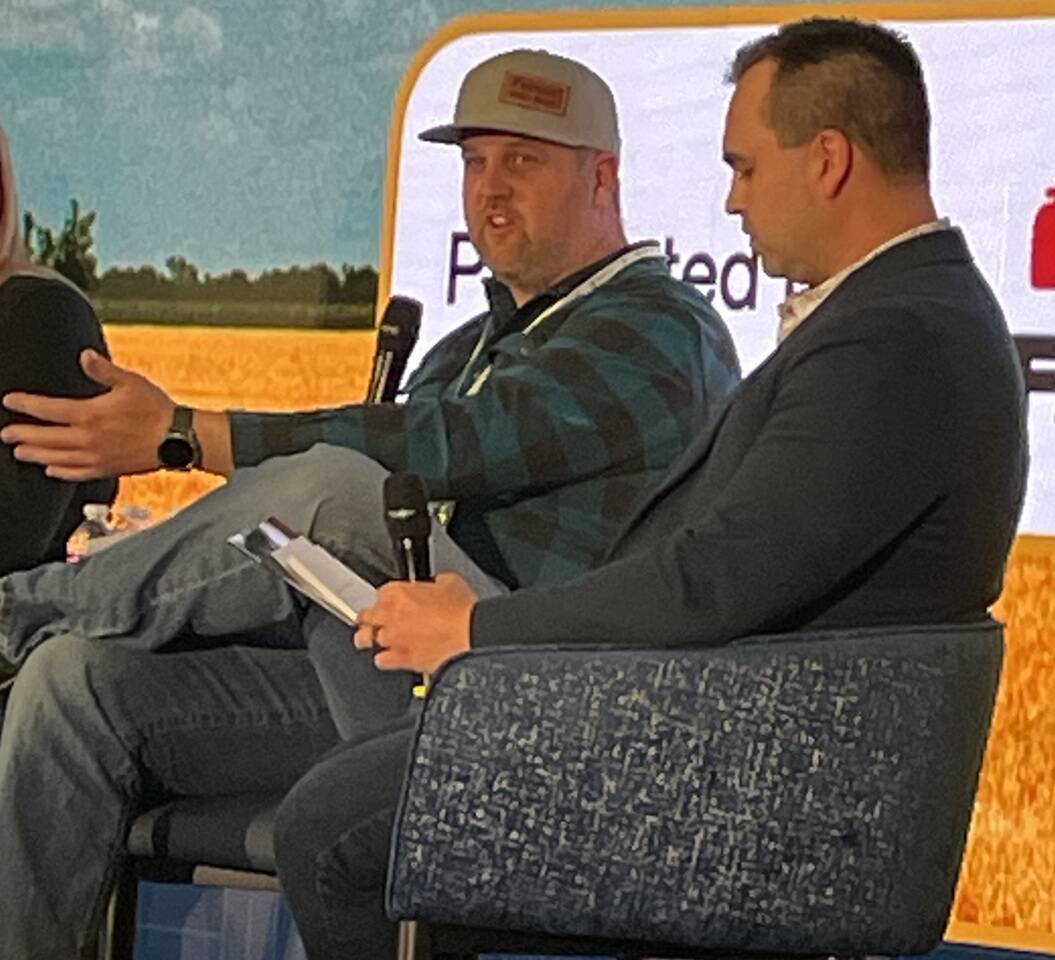
With AdFarm’s Brady Stadnicki serving as moderator, three Alberta producers were questioned on how they’ve innovated on their farms as well as some of the macro issues facing ag today.
The producer participants included Josh Fankhauser, a fifth-generation lamb farmer from Claresholm; Emily Ford, senior agronomist with Quattro Ventures and Bow Island-area producer; and David Benjamin, a first-generation hay and forage farmer in southern Alberta.
Read Also
Prairie spring forecast: What weather models predict for March to May
Weather models offer varied outlooks for Prairie spring. This forecast review compares Old Farmer’s Almanac, NOAA, CFS, CanSIPS, and ECMWF predictions for March through May temperatures and precipitation.
Q: When you think about your farm over the next three-to-five years, what do you see on the horizon, whether it’s an opportunity or a challenge or a big decision that you’re looking to make?
Ford promoted a positive perception of AI’s role in agriculture.
A: “There’s so much technology out there right now and there’s a lot coming at us and it’s really fast, but I don’t know if we’re using it to its full potential yet as far as AI and all these sorts of things,” she said.
“So I think in the next three-to-five years, (AI is) going to help us streamline our decision-making process (and) hopefully add clarity to some of the decisions that we make, enable us to use the data that we collect so much of to make actual decisions that can help and reduce some of the noise.”
Q: I’m curious to know what areas you’re managing most on the farm today.
Although Fankhauser enjoys seeing a group of employees evolve into a well-oiled machine, he said getting to that point can be a challenge.
A: “If you can keep the labour part working and you can kind of somehow build a team that makes everything go right, if you can get trustworthy people, then the rest is easy,” he said.
“How to build teams and how to make the teams work together is kind of my biggest challenge. And you always got new ones coming in and old ones leaving and dynamics are constantly changing.
“It’s just something that you don’t think about as a farmer … that you’re an HR manager now, and that’s pretty much my role: HR.”
Q: What tools or technology are you most interested in right now?
Fankhauser is interested in precision spraying technology such as green-on-green and green-on-brown, but is still working out how they would fit into his operation, adding he may skip the new ground spray tech altogether and buy a drone.
A: “Some of this drone AI self-learning tech could be pretty beneficial, especially when you want to do off-the-wall things like spot spray or you just want to spray this plant in this row.”
Benjamin talked about the challenge of separating needs and wants with farm tech.
A: “If you’re looking online at a trade show, there are a lot of cool things on each side of that spectrum. So you take half of that spectrum and say, ‘I’m going to focus on the needs first (and) dream later’.”
Q: Are there some areas in your operation where you wish there was a better solution or something new, maybe something that just isn’t quite developed yet, but would solve a pain point?
The solution to any challenge exists somewhere, said Benjamin, but it may require stepping out of one’s comfort zone.
A: “Agriculture is a fantastic industry that has some of the smartest people working in it, and that solution does exist. It’s knowing where to go and, as an example, when we upgraded our no-till drill, we couldn’t find what we needed within our local dealer circuit.
“So in 2023 we travelled to Agritechnica and crawled under every drill essentially available in the world. So we had to go to Germany … to find some of this information.”
Q: What are one or two things you wish companies understood better about your operation and how you make decisions?
One of Fankhauser’s biggest pet peeves is doing business with people who are unaware of the scale and nature of modern farming.
A: “We’re not Old Macdonald’s farm anymore. There’s very few farms I know that could actually fit that model. Even a small farm (or) what we would consider small is (a) multi-million dollar enterprise.
“We’re the C-suite, right? We’re the CEOs, the CFOs and all those people. And when you come to sell me something or present me something, I will do my homework on you. So … you better do your homework. Send somebody with knowledge.”
Q: Can you think of one small change on your operation that had a bigger impact than you expected?
A: “I can think of one, and it seems simple, but it’s been so effective,” said Ford.
“Every year we send out a survey to our employees (and) ask them … what would make your life easier to come to work every day? What’s something that you need in the shop?
“As a management group, we review the results once a year, and that’s where we drive what we’re going to work on for the coming year. And it’s all based on our employees’ feedback on how to make it a better place to work. And we’ve had great success and improved employee retention and things like that, just by listening and giving them a platform.”
Benjamin also likes to turn to employees for input. Sometimes the question can be as simple as “What do you want to work on?”
A: “Sometimes you’d be surprised at what these people respond with what they want to be involved with on the farm, whether it’s a contractor or an employee.”