As this recent war has broken out in the Middle East, it reminded me of another relatively short-lived war in the same region 35 years ago called Desert Storm.
It was 1991, and I don’t remember the exact dates of that conflict that was a United States-led operation involving a coalition of 42 countries, determined to remove Iraqi (Saddam Hussein) forces that had recently invaded oil-rich Kuwait.
Now fast forward 35 years and many world conflicts later, and we have the U.S. and this time Iran bombing the living (fill in the blank) out of military, government, energy and civilian targets across several Middle Eastern countries, and it’s almost regarded as “just another day in Donald Trump’s world — who is getting bombed today?”
Read Also

Livestock receipts drive farm cash to $101B despite crop decline
Canadian farm cash receipts rose to $101 billion in 2025 as surging livestock revenues offset declining crop receipts and shrinking direct government payments.
What does snap me back to reality is the price of gas in my world, which over the first couple weeks of March has been increasing steadily. With oil production and shipments through the Persian Gulf — about 15 million barrels or 20 per cent of the world’s oil needs daily — essentially cut off, at the time of this writing, gas in Calgary was about $1.50 per litre with some forecasts warning that $2 per litre might be ahead.
News reports in the past couple days have also been describing how the interruption in oil supply will affect agriculture and food prices. What might be a temporary shortage of oil will result in much higher nitrogen fertilizer prices in 2026.
As of last week, the price of urea (nitrogen) had already jumped 37 per cent in Egypt going from $485 to $665 per metric tonne. In New Orleans, the price had already increased from $516 on to $683 per short ton. Ammonia was $505 per metric ton — a $30 increase in one week. And the U.S. Gulf prices for DAP (phosphate) had increased five per cent to $655 per metric tonne.
Hopefully many producers already had fertilizer prices or supplies locked in for the 2026 growing season, so these higher prices may not have a major impact until next year.
News reports left the impression that with an increased cost of fuel and fertilizer that farmers will be charging more for their grains and livestock which will result in higher food prices. I don’t doubt there will be higher food prices in the days and weeks ahead, but unless the reality of agricultural economics have suddenly changed, it won’t be because farmers are passing along the higher production costs. Producers will do their best to absorb the increased costs, with hopes that buyers will increase the amount they are able to pay.
The Bunny Hugs Farmers podcast features two Prairie farmers speaking about everyday things happening on their farms.
— Lee Hart
Photo: submitted
Down-to-earth farming topics
If you’re looking for a diversion from the unfolding and ongoing world drama, check out a Western Canadian, farmer-based discussion every two weeks called the Bunny Hugs Farmer podcast.
Created and hosted by Saskatchewan producers Dallas Leduc of Glentworth and Tyler Jaenen of Moosomin, these are just two everyday grain and oilseed producers who team up every couple of weeks to talk about what’s happening on their farms — just everyday stuff. And they often have a guest who joins in on the conversation to talk about a wide range of topics — cattle markets, grain markets, field scouting, beef production, machinery, farm shows and you name it.
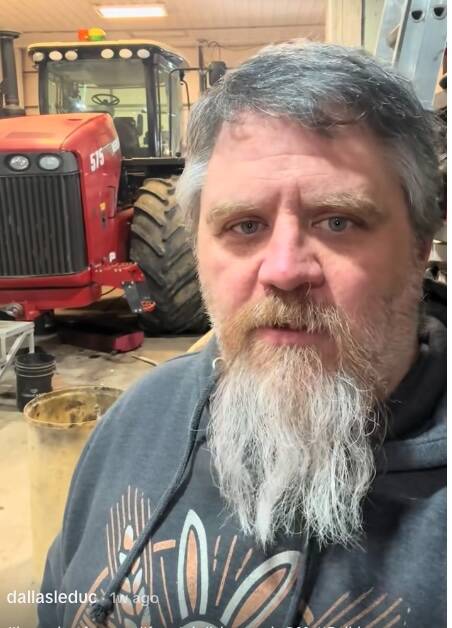
Saskatchewan farmer Dallas Leduc is one of the founders of the Bunny Hugs Farmer podcast.
Photo: submitted
I have never met either of the podcast hosts, although Dallas and I have known each other for several years. As he, along with family members, farm about 10,000 acres of grains, oilseeds and pulse crops in southern Saskatchewan. He has been a great help over my years of reporting, talking about what works or doesn’t work on their farm and thoughts on the agriculture industry in general.
Dallas and Tyler didn’t know each other either, but connected through social media and decided early in 2025 to try their hand at producing a podcast. There’s no particular theme, but as Dallas describes, “each episode dives into real farm stories, local issues, and industry insights,” about all sectors and aspects of agriculture. And it certainly isn’t all serious and dry, they make a point of having lots of laughs as well.
“Often we have no idea of what we’re doing,” said Dallas. “We hope our discussion is informative and entertaining. And we are always working to make the next podcast better than the last one.”
They put their own time and money into the project. They have no advertisers or sponsors.
So check out the Bunny Hugs Farmers podcast, which is available on a wide range of social media platforms.