

As I was a hauler of water in Calgary this late March morning, I was grateful that I didn’t also need to be a hewer of logs. Such is the life here in the Alberta wilderness.
I was carrying buckets of water into the house this day, after a sudden failure in the waterline that serves the houses on our street meant the water was to be shut off for a couple days while the city completed repairs. It doesn’t take long for you to realize dry water taps in the kitchen sink is certainly a pain in the butt.
However, the city spotted water wagons along the front street so people could fill buckets and jugs with potable water to get them over the hump. Fortunately, with decent early spring weather, packing a few pails of water a few feet into the house was more an inconvenience than a hardship.
Read Also
Southern Alberta irrigation district sets healthy 2026 water allocation
Southern Alberta farmers get good news in their water allotment for the 2026 growing season, which has nearly doubled in two years emerging from drought.
The repairs to that 50-plus year-old waterline in my neighbourhood was over and above the well-reported billion dollar-plus repairs going on elsewhere in Calgary to replace a main water feeder line that is essentially being held together with fencing wire and duct tape. We were already doing our best to reduce water use as the main line is being replaced, and now having to carry water into the house for a couple days made us even more conscious of water use.
A dry spell in the 1960s
These Calgary water issues had me thinking of only a few times in my life, either due to drought or distribution issues, I have experienced some degree of water shortages.
The first “dry” spell I remember was probably one year in the early 1960s when it just didn’t rain in eastern Ontario. In that part of the world south of Ottawa, that generally gets lots of rain, the more common complaint was usually about too much water rather than not enough. So to me, perhaps as a 12- or 13-year-old, a drought year was memorable.
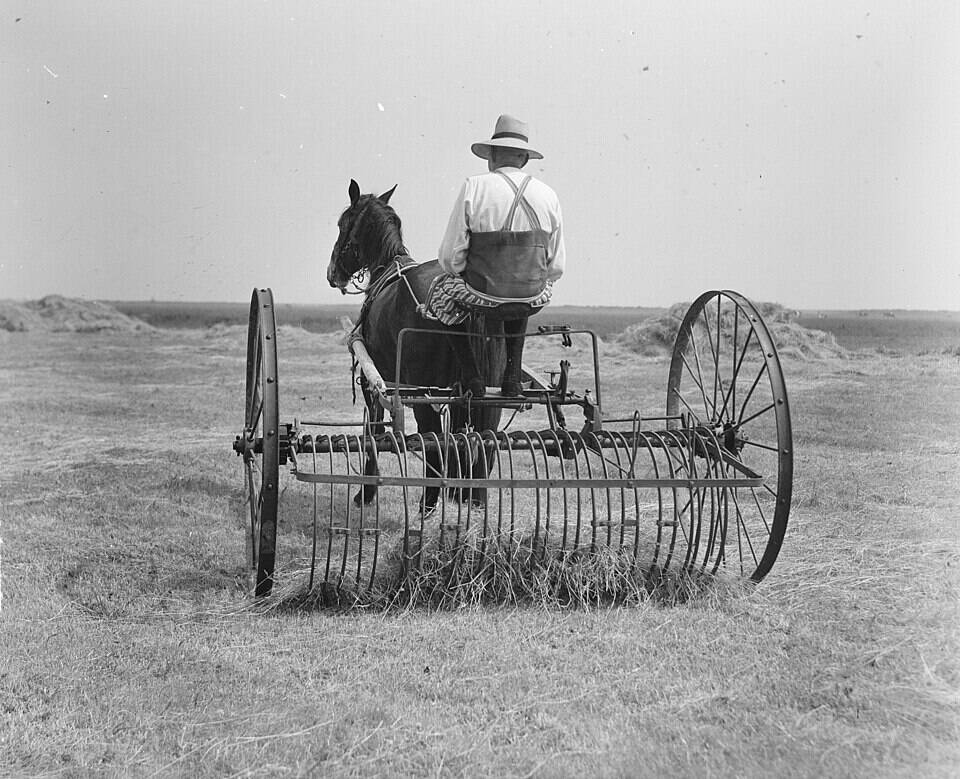
One consequence of that dry growing season was a shortage of pasture and being able to put up enough hay for winter feed for the dairy cows. It meant that every stem of grass counted. It was the only time I remember some of the long-retired horse-farming technology being pressed into service.
The dump rake comes out of retirement
In the early 60s, it had been more than a decade since horses were last used on the farm, but if I ever wondered why an old dump rake still sat in the weeds along a fence line, I was soon to learn the reason.
My grandfather, who was raised on a farm in England in the late 1800s, was a very practical and waste-not-want-not man. On the work bench in the shop at his house, for example, there were always jam jars filled with good used nails that he had painstakingly straightened out with a hammer on the anvil. How many people out there today save and straighten used nails? I don’t expect to see too many hands raised.
But in that dry growing season when hay crops were short, he and my dad decided to park the ultra-modern New Holland side delivery rake that wasn’t very efficient at turning short hay into a windrow and put the old 12-foot wide dump rake into service.
The dump rake, with tines that scratched across the field like a comb, used to be pulled by horses, but was now to be hooked up to the little grey Ford tractor which I drove. It wasn’t complicated technology, although it took a while to figure out timing. I had to pull a rope connected to the trip lever on the rake that caused the tines of the rake to curl up and dump what hay it had collected.
I had to time it so that each “dump” added to a reasonably straight windrow. It took some practice, but eventually I was able to collect up two or three thin swaths of mowed hay to make an acceptable windrow to be picked up by my dad who was using the Allis-Chalmers tractor on the square baler. Meanwhile, my grandad patrolled the field on foot with a hay fork collecting any bits of hay that were missed, throwing them into the next windrow.
There weren’t many stems of dry hay left behind that year. It must have worked because I know the cows were fed that winter.
Lee Hart
When the wells ran low
Also that same dry year, I remember the two hand dug wells that supplied water to the house and the barn were critically low on water that fall. These wells that were perhaps three feet in diameter and about 30 feet deep, cribbed with stone, were dug in the 1800s when the farmstead was created, and had proved to be a reliable source of water for nearly a hundred years at that time (and are still being used today). However this year the water table was extremely low which meant the wells were barely recharging to meet daily needs.
There were plenty of creeks in the area, but nothing that offered a clean or abundant water supply. Fortunately we lived within a reasonable distance to the St. Lawrence River and the Seaway (hydro electric) Project had been completed in 1959. As part of that project, and with a shortage of gravel, limestone rock was blasted and crushed to make fill needed for the construction, and these operations left behind fairly deep quarries covering a few acres, which soon filled with water once work was completed.
One of these quarries, now known as the Challies Pond (about 30 feet deep and covering six acres), was located less than five miles from the farm. My dad located a 200 gallon steel tank, mounted it on a hay wagon and outfitted it with a gas-powered water pump. Pulling the wagon with the tractor, he or my older brother made several daily trips that fall to the nearby quarry to bring water back to replenish the wells so both cattle and household had water. We made it through.
The best Christmas present
As it turned out, following a dry, mild fall it started raining on Christmas Day. I don’t know how much rain fell, but after a few days well water levels improved, and my dad always described it as the best Christmas present he could ever receive.
I doubt I will feel quite the same joy when the city turns the water back on, but I will admit to having a greater appreciation for being able to have an ample, clean, fresh water supply just by turning the tap. At least for a little while I won’t take “a little thing” for granted.